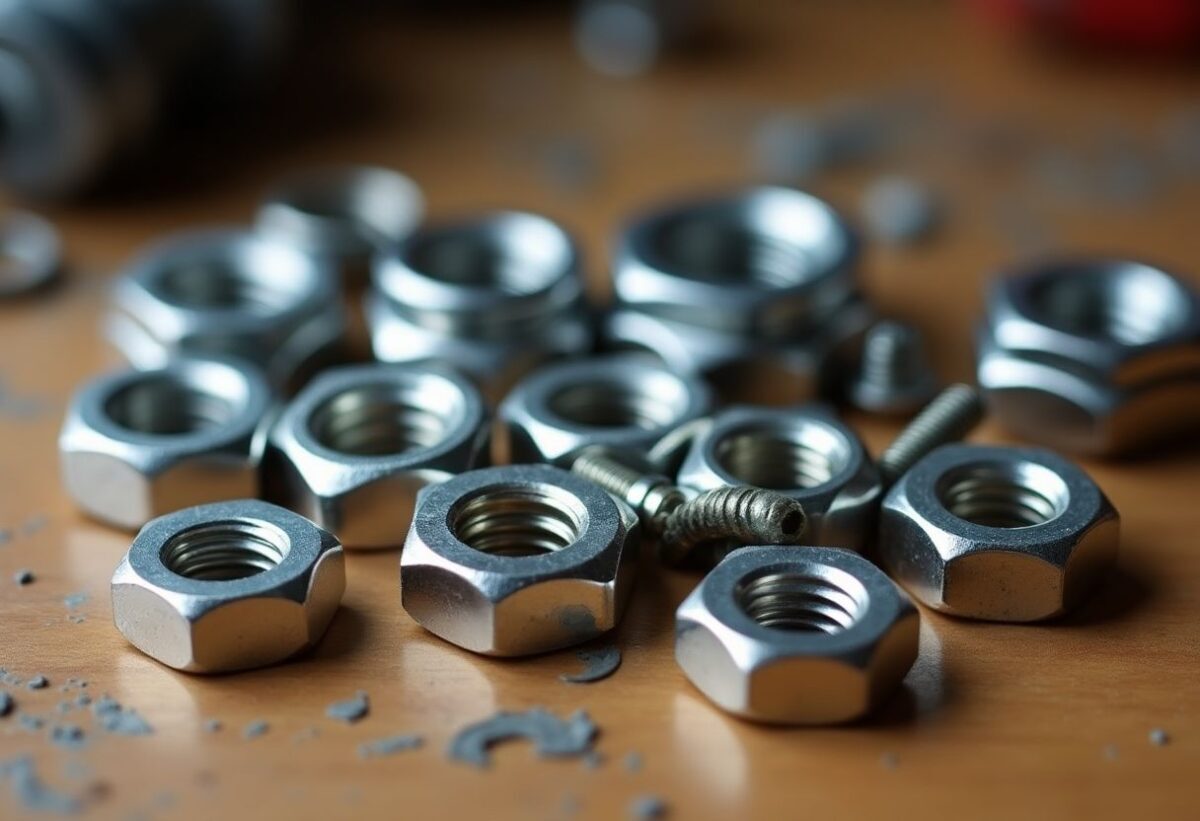
Mechanical engineering is full of fascinating components, some of which are so discreet that they often go unnoticed. Yet, their role is vital. Among these elements is the lock nut, a key player in maintaining the safety and reliability of mechanical assemblies. Whether in vehicles, industrial machines, or even household appliances, this nut is ubiquitous. Understanding its function, types, and applications can provide new insight into the importance of this small but powerful element.
What is a lock nut?
The lock nut is an essential component that prevents the spontaneous loosening of bolted assemblies due to vibrations or dynamic loads. Indeed, these nuts are designed to ensure a durable and secure fastening.
- Functioning: Their functioning relies on various mechanisms, such as nylon inserts or thread deformations that increase friction.
- Applications: They are widely used in the automotive industry, aviation, and construction, where safety is paramount.
The different types of lock nuts
There are several types of lock nuts, each with specific characteristics suited to various applications. Their selection depends on the context of use, the nature of the forces involved, and environmental conditions.
- Nylon insert nut: Renowned for its ability to absorb vibrations, the nylon insert creates a strong resistance to loosening.
- Collar nut: This type uses a metal collar that elastically deforms to increase friction and maintain tightness.
- Self-tapping nut: It is designed to self-lock due to a deformation of the thread.
- Serrated nut: Ideal for applications requiring a high tightening torque.
Choosing the right lock nut
Selecting the right lock nut requires an understanding of technical specifications. The right choice ensures not only safety but also the durability of the assembly.
Consideration must be given to temperature resistance, compatibility with surrounding materials, and load characteristics. Extreme temperature conditions and the presence of chemicals can influence the performance of certain nuts. A nut with a nylon insert may not be suitable in a high-temperature environment.
Advice from a mechanical expert can prove invaluable in avoiding costly mistakes.
Advantages and limitations of lock nuts
While lock nuts offer many advantages, it is also important to recognize their limitations for optimal use.
Advantages:
- Effectively prevents loosening due to vibrations.
- Easy to install and remove without special tools.
- Available in a variety of materials to suit different environments.
Limitations:
- May not be suitable for extremely high or low temperatures.
- Some types may be susceptible to corrosion, requiring special surface treatment.
- Cost may be higher than standard nuts.