
Beauty and health sites accumulate pages: product sheets, dermatological advice, care categories, booking modules. The main menus show only a fraction of this content. The rest is buried several clicks deep, sometimes inaccessible from the current navigation.
The sitemap page, often relegated to the footer, offers direct access to the complete structure of the site. Its usefulness goes beyond simple technical SEO.
Accessibility and keyboard navigation on a health and beauty site
Beauty and health sector sites frequently integrate interactive visual components: product carousels, filters by skin type, service selectors in salons, drag-and-drop appointment booking modules. These elements work well with a mouse but pose difficulties for people navigating with a keyboard or assistive technology.
The WCAG 2.2 principles require that every journey based on a visual gesture has an accessible alternative. A carousel without keyboard control, a filter activated only by clicking on a non-focusable area, a fixed banner that obscures focus: these are common situations on cosmetics or wellness sites.
A well-constructed HTML sitemap circumvents these obstacles. It provides a list of text links, organized by theme, that any screen reader can navigate linearly. For a user who cannot navigate a complex dropdown menu, this page becomes the most reliable entry point to the sought-after content.
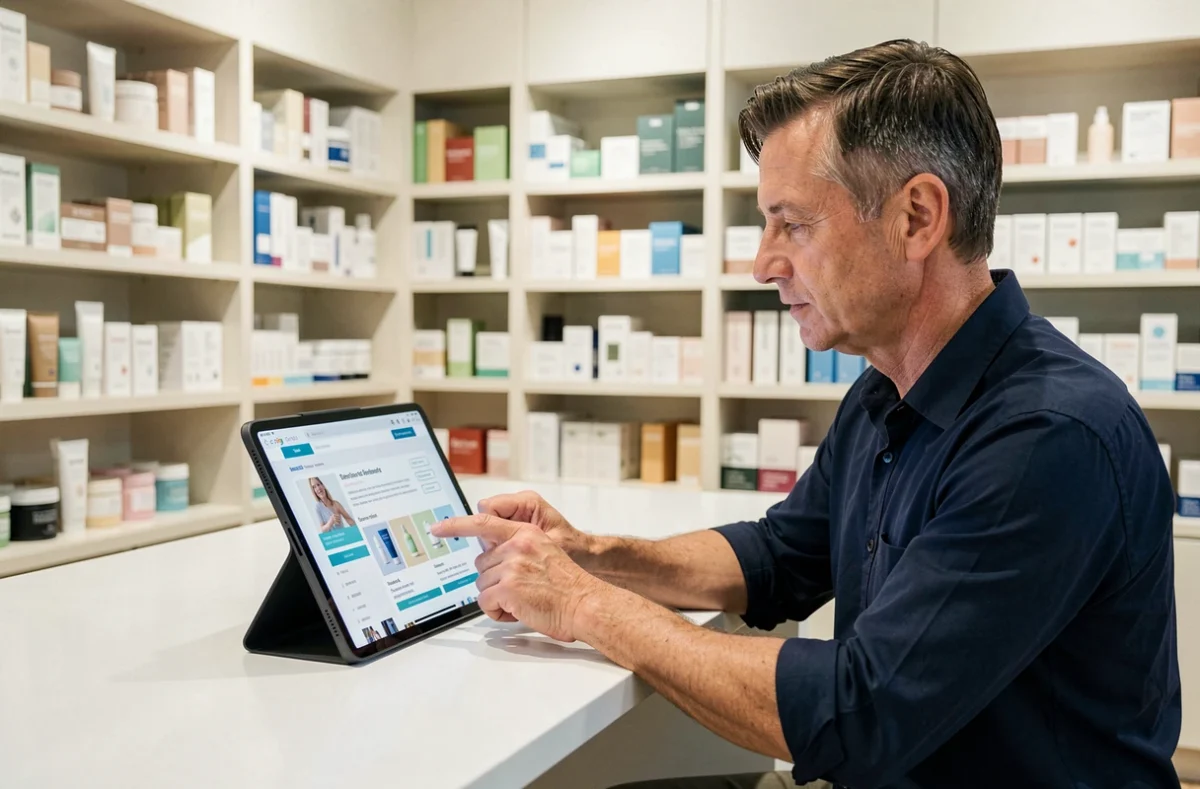
On the sitemap page of Beauty Health, the structure groups the different sections of the site into a readable index, which concretely illustrates this navigation aid function.
HTML Sitemap and consistency of navigation landmarks
WCAG 2.2 introduces a criterion often overlooked by site publishers: help mechanisms must appear in the same relative location on all pages. A contact link, a phone number, access to chat must remain consistently positioned from page to page.
In practice, beauty and health sites present very different page templates depending on the sections. A cosmetic product sheet, a blog page on care routines, and a booking form in a salon do not have the same layout. The link to customer service may migrate from the header to the footer, or even disappear on certain templates.
The sitemap as a stable reference point
The sitemap page remains, by nature, a unique model. Its structure does not vary depending on the context. It can serve as a fixed reference point to find help, contact, or medical information pages, regardless of the layout changes of the rest of the site.
This stability is particularly useful on sites that offer both beauty products and health-related content. A visitor looking for information on the ingredients of a serum or the precautions for using a home care device needs clear landmarks.
What the structure of a sitemap reveals about the quality of a beauty site
Consulting the sitemap of a beauty and health site provides insights that traditional navigation does not offer. The raw list of URLs exposes the actual depth of the catalog, the presence or absence of advice pages, and the classification logic adopted by the publisher.
A site that displays several hundred product sheets but no information page on composition, contraindications, or usage protocols sends a signal. Conversely, a sitemap rich in editorial content pages indicates an effort for transparency regarding the products and services offered.
Identifying missing content or orphan pages
The sitemap also helps detect inconsistencies:
- Categories announced in the main menu but absent from the sitemap, which may signal unindexed pages or those deleted without redirection.
- Orphan pages (accessible only via the sitemap) that contain useful information about an active ingredient or a type of care.
- Duplicate URLs or variants of the same product page, a symptom of a technical issue that dilutes the site’s relevance for search engines.
For an informed consumer, browsing the sitemap is akin to consulting the complete layout of a store before entering. One can spot existing aisles, those that are missing, and assess the coherence of the offering.

Sitemap and searching for beauty products: limits and concrete cases
The sitemap does not replace a high-performing internal search engine. On a site offering several hundred cosmetic references, browsing a linear list of URLs remains tedious. The sitemap is useful when internal search or filters fail, not as a daily navigation tool.
Field feedback varies on this point. Some assistive technology users consistently prefer the sitemap over the main menu because the list of links is predictable. Others never access it, either because they do not know the page exists or cannot find the link (often relegated to the bottom of the page in small print).
Link titles and readability
The quality of a sitemap directly depends on the clarity of the titles. A link named “Product-SKU-4872” helps no one. A title like “Hyaluronic Acid Serum – Dehydrated Skin” immediately provides the necessary information.
On beauty and health sites, where product lines sometimes have fanciful names, a sitemap with descriptive titles compensates for the lack of clarity of brand names. The visitor can identify the product by its function rather than its brand name.
The available data does not allow for precise measurement of the impact of an HTML sitemap on the conversion rate of a beauty site. However, its role in accessibility and navigation transparency is documented by the WCAG 2.2 criteria, which apply to all sectors, including health and wellness.