The daily flourishing of children relies less on grand theoretical principles and more on repeated micro-decisions made by parents. Autonomy, emotional management, self-confidence: it is the concrete mechanisms that connect these dimensions that matter in everyday life.
Co-created routines with the child: a concrete lever for autonomy
A routine imposed by the adult structures the day. A routine co-created with the child structures their thinking. The difference is fundamental. From the age of 4, a child who can participate in the development of their own temporal markers develops a sense of control over their environment, which directly feeds into self-confidence.
Several recent studies on family routines confirm this observation: families that have established routines designed with their children report a decrease in daily conflicts. The mechanism is simple: the child who has chosen the order of their evening activities (bath, reading, tidying up) no longer perceives the instruction as an external constraint.
In practice, we recommend offering three fixed time slots (waking up, returning from school, bedtime) and allowing the child to decide the sequence of tasks within each slot. You will find additional ideas by browsing the articles for children on Une Famille that detail this type of approach by age group.
Mindfulness in the family: what regular practice changes
Since 2024, parental programs integrating mindfulness into family routines have been multiplying. Several educational institutions document a reduction in behavioral crises among children exposed to these practices. We are not talking about formal meditation sessions, but about two to three-minute breathing exercises integrated into daily life.
The effectiveness depends on regularity, not on the duration of the sessions. A short exercise repeated every evening before bedtime has more effects than an occasional long session. The parent who practices alongside the child reinforces the mirroring effect: emotional learning occurs through imitation before becoming a conscious process.
Three formats work particularly well in a family context:
- Guided breathing with an object (a stuffed animal placed on the child’s belly while lying down, rising and falling with the breath) – applicable from age 3
- Sensory scanning upon returning from school: naming five things seen, four sounds heard, three textures touched during the day
- The gratitude ritual at dinner, where each family member mentions a positive moment, which develops attentional capacity and emotional regulation
Screen limitation before age 6: the French regulatory framework of 2026
The circular from the Ministry of National Education in January 2026 imposes strict recommendations limiting screens before age 6 in daycare centers. This text, published in the Official Bulletin No. 10 of January 15, 2026, guides childcare structures towards alternative sensory activities for optimal cognitive development.
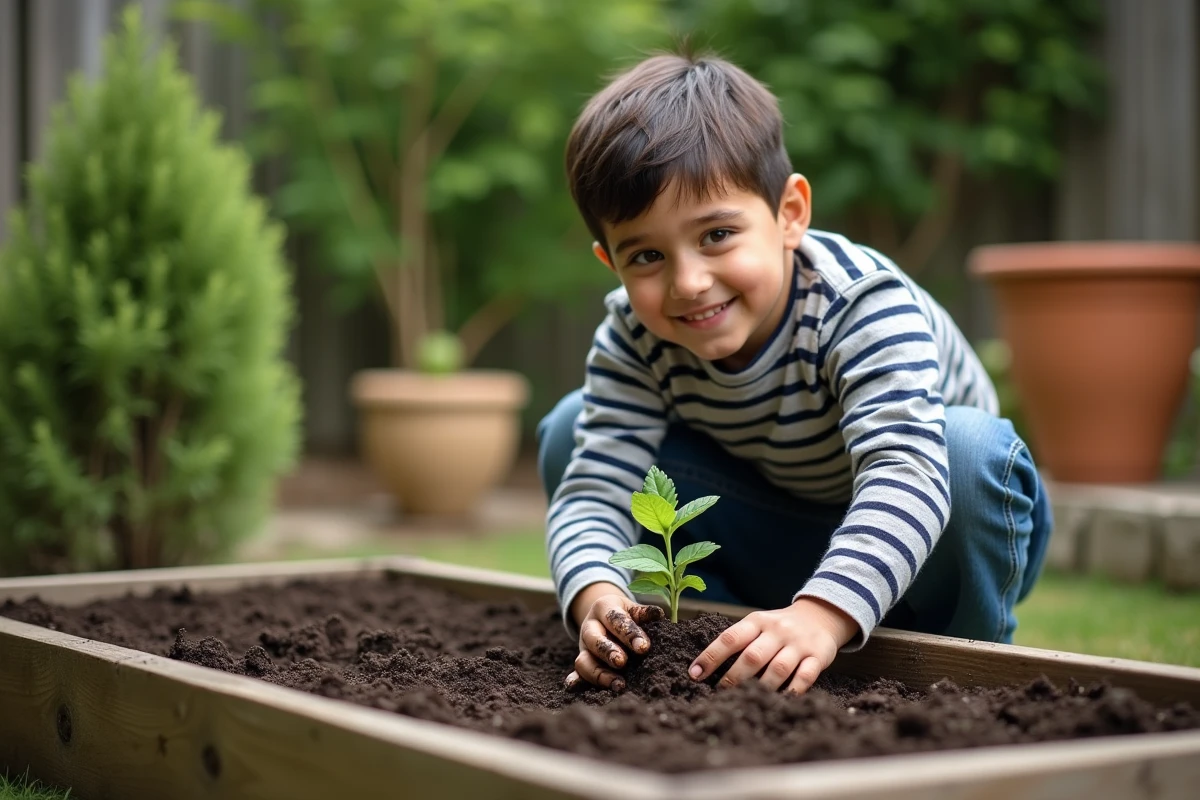
For parents, this circular does not have binding force at home, but it sets a clear institutional benchmark. Replacing screen time with manual activities (modeling clay, construction, gardening) or free outdoor play yields measurable benefits for fine motor skills and concentration capacity.
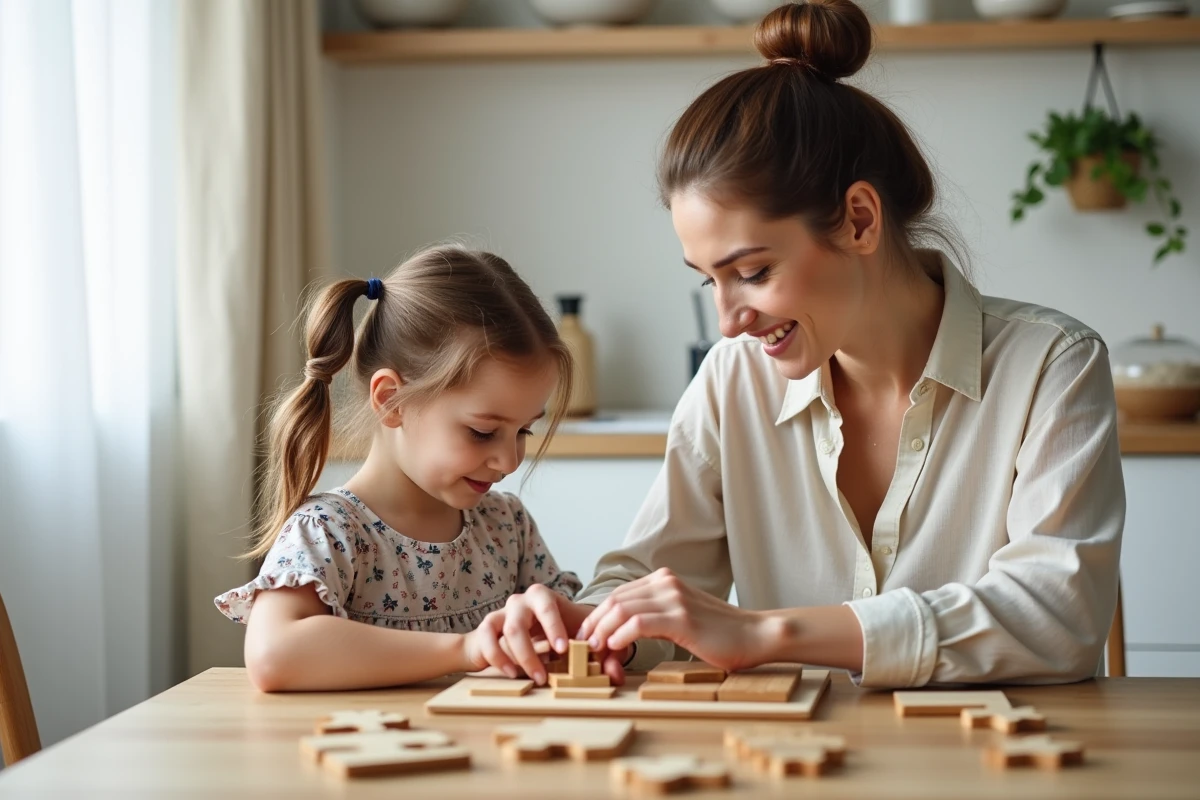
A common pitfall is to replace the screen with another adult-directed activity. Unsupervised free play remains the most favorable format for flourishing, even when the child is bored. Boredom, far from being a void, triggers creativity and personal initiative.
Nordic approach to outdoor play: differences with the French model
Scandinavian models of preschool education are based on a principle that we underestimate in France: free outdoor play all year round, including in cold or rainy weather. This approach shows a qualitative superiority in terms of flourishing compared to Mediterranean models, which are more focused on indoor learning.
The benefits of prolonged outdoor play are not limited to physical exertion. A child playing outside without specific instructions develops three skills simultaneously:
- Calibrated risk management (climbing, jumping, assessing distance), which builds bodily confidence
- Spontaneous social negotiation with peers, without constant adult arbitration
- Observation of living things (insects, plants, weather), which nurtures scientific curiosity well before entering formal learning cycles
We recommend a minimum of daily unstructured outdoor time, even in a small space like a shared garden or a courtyard. The absence of an explicit educational goal is precisely what makes this time educational.
Valuing effort rather than results: the precise mechanics of confidence
Saying “you worked well” produces a different effect than “you succeeded.” The first formulation reinforces the intrinsic motivation of the child, while the second conditions their satisfaction on an external result. This distinction, well documented in research on positive education, remains poorly applied in daily life.
The mechanism is as follows: a child praised for their effort develops a significantly higher tolerance for failure. When faced with a difficulty, they persevere because the process itself has been valued. A child praised for their results gives up more quickly when they perceive a risk of failure, as failure directly threatens the competence image that has been constructed for them.
In practice, this means describing what you observe (“you tried this drawing three times, I see you were looking for the right color”) rather than making a global judgment (“it’s beautiful”). Fact-based description replaces evaluative praise.
Supporting daily flourishing requires neither specific materials nor prior training. It relies on fine adjustments in parental posture: co-constructing routines, practicing mindfulness together, freeing up time for unstructured play, and reformulating encouragements. These four axes, combined with the regulatory framework that is becoming clearer in France regarding screens, outline a coherent foundation to support the child’s development over time.